


Many family offices spend countless hours discussing market risk. Investment committees debate inflation, interest rates and geopolitics, and the quarterly reporting tracks every move. Yet the data suggests that the biggest challenges to a family office's continuity sit much closer to home.
What family offices rank as their biggest risks
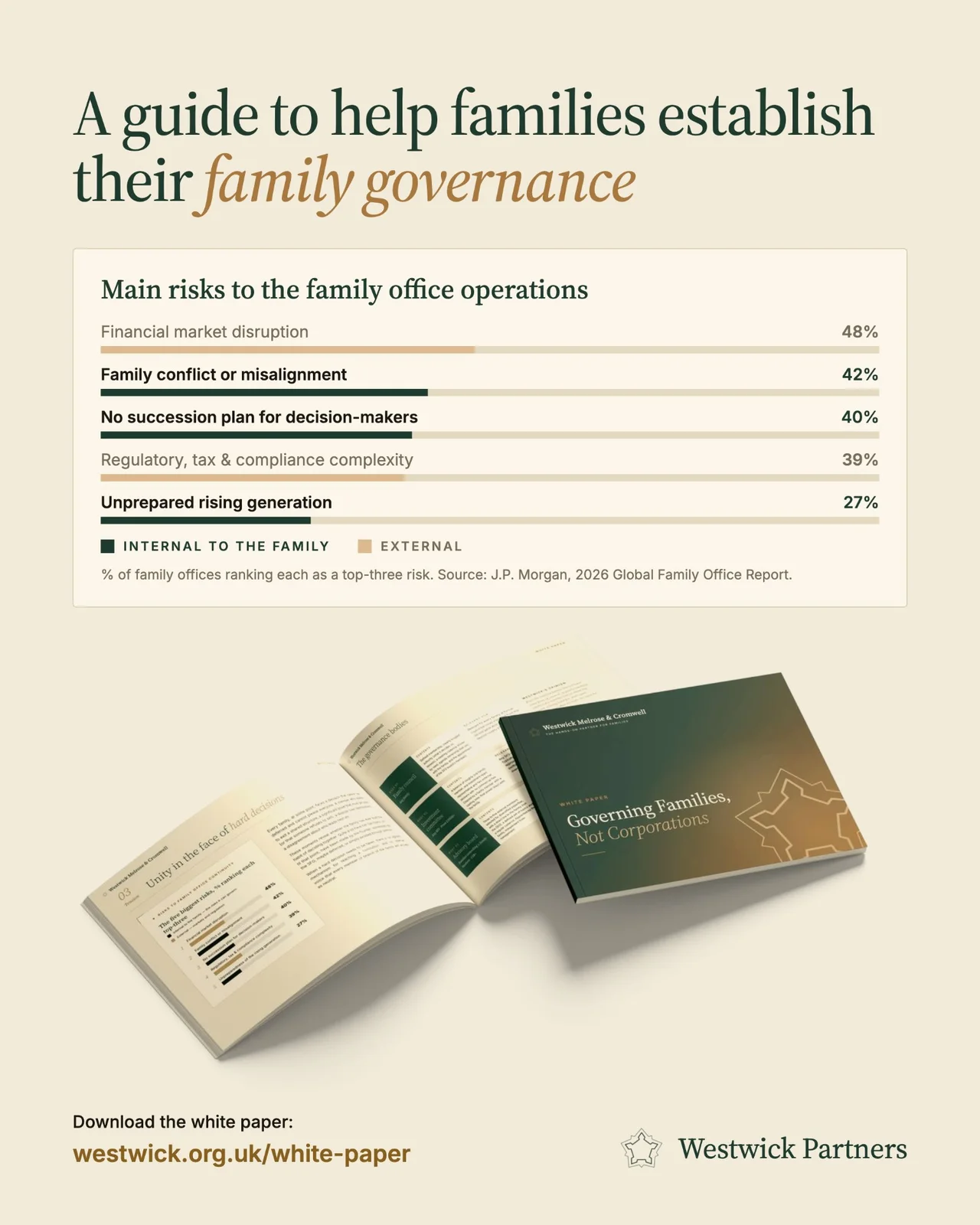
In its 2026 Global Family Office Report, J.P. Morgan asked 333 family offices in 30 countries to name their top three risks to continuity. Five came out ahead:
- financial market disruption (48%)
- family conflict or misalignment (42%)
- no succession plan for decision-makers (40%)
- regulatory, tax and compliance complexity (39%)
- an unprepared rising generation (27%)
Three of the five are internal to the family. The two external ones are largely out of the family's hands. The other three are the risks a family can actually govern.
What those risks look like in practice
Not inflation, interest rates or geopolitics. A sibling who wants out of a shared structure. A disagreement over the sale of a major asset, or a refusal to sell it. A next generation that inherited ownership without ever being involved in a decision.
Those moments come to every family of significant wealth. They cannot be deferred, and they cannot please everyone. And they reveal whether the family has ever built the habit of deciding together.
Many have not. Until then, the founder decided, sometimes the family office did, and some decisions were simply avoided. Nobody had to agree on a process, because the need never felt urgent. When the hard decision arrives, there is no agreed way of reaching a conclusion, and no voice that every branch of the family accepts as neutral. The outcome is then set by whoever speaks loudest, holds the most capital or has the strongest legal position, rather than by what the family wants.
Unity in the face of hard decisions
We call this tension "Unity in the face of hard decisions". It is one of three recurring tensions that every family of significant wealth will face at some point. The other two, the founder and the family, and the family office's expert team, are explored in our white paper, Governing Families, Not Corporations, along with the tools families use to stay in control.
A family cannot build that habit on the day a sibling asks to leave. It has to be in place well before.
Frequently asked questions
What are the biggest risks to family office continuity?
In J.P. Morgan's 2026 Global Family Office Report, 333 family offices in 30 countries named their top three risks to continuity. Five came out ahead: financial market disruption (48%), family conflict or misalignment (42%), no succession plan for decision-makers (40%), regulatory, tax and compliance complexity (39%) and an unprepared rising generation (27%). Three of the five are internal to the family.
Why are internal risks different from market risk for a family office?
Market disruption and regulatory change come from outside, and a family has little hold over them. Family conflict, the absence of a succession plan for decision-makers and an unprepared rising generation are within its reach. They are the risks a family can actually govern, provided it has built a way of deciding together before a hard decision arrives.
What does unity in the face of hard decisions mean?
It is one of three recurring tensions that every family of significant wealth faces at some point, set out in Westwick's white paper Governing Families, Not Corporations. Every family eventually meets a decision that cannot be deferred and cannot please everyone, such as a member who wants to exit or a major asset sale. Those moments reveal whether the family has ever built the habit of deciding together. The other two tensions are the founder and the family, and the family office's expert team.