
Family Office Knowledge Base
We publish in two forms. Insights are short practitioner pieces — observations from inside family office mandates. The Knowledge Base holds our longer guides: deeper reading, intended to be read in full.
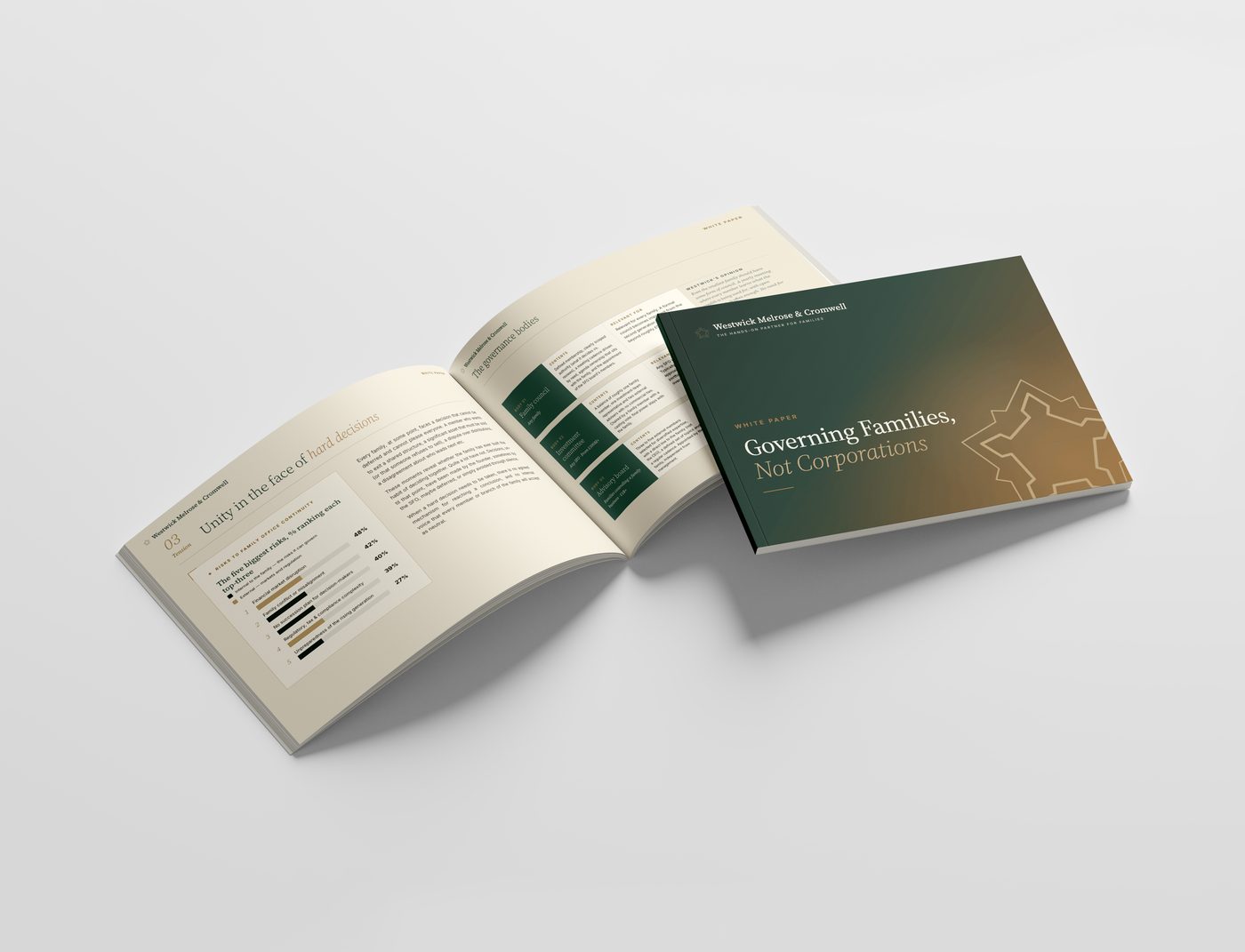
Governing Families, Not Corporations
Family governance is how families stay in control — borrowed governance is often how they lose it. The three tensions, the governance tools, and three real cases.
Read the white paperWestwick Melrose & Cromwell is now Westwick Partners
The practice founded as Westwick Melrose & Cromwell now trades as Westwick Partners. Same partners, same mandates, same address.
How to Choose a Wealth Manager for a Family Office
The durable criteria that separate a useful wealth manager from a well-marketed one, seen from inside a family office.
The Family Office Investment Committee: How Families Keep Control of Their Own Capital
The investment committee is where a family decides how its capital is used. Built well, it keeps the family in control. Built badly, it hands that control to the room. A practical guide to composition, mandate, and the line between deciding and executing.
Family Office Services: What a Family Office Actually Does
"Family office services" is what the market sells. Seen from inside the office, they are functions, and the list is shorter and harder than the brochures suggest. A working map of what a family office does, and what it should never delegate.
What Is a Family Office? A Practitioner's Guide
Everyone in wealth management now wants to sell to family offices. Few can say plainly what one is. A practitioner's definition: what a family office does, what it costs, and how to tell a real one from the label.
Family Office Succession Planning: Preparing the Family and the Office
Succession is the moment a family is most likely to lose control. Handled early, it becomes a family project. A practical guide to preparing the next generation, the knowledge one person holds, and the team that has to evolve.
The Interim Family Office CEO: When It's Needed and What For
What an interim family office CEO is for: keeping the office and its live projects running, understanding why the seat came empty, and helping the family choose the right permanent leader.
Founder Syndrome: when one person is the only governance
86% of single family offices have no succession plan, yet most expect to pass control within a decade. The founder's authority became the structure. That is Founder Syndrome.
Family Constitutions: What to Write, and What to Leave Out
Most family constitutions are long, bank-drafted and unread. The short one a family writes itself is the one it reaches for when a decision splits the family. What belongs in it, what to leave out, and who should hold the pen.
Family governance is not corporate governance
Corporate governance and family governance share a word and almost nothing else. One protects outsiders. The other keeps a family in control of what it owns. Confusing them is how families lose what they built.
Bill Ackman's family office: trust is not a governance model
Bill Ackman made the story of his own family office public: a decade of costs growing unchecked behind complete trust. Trust was never the problem. The absence of governance was.
Single Family Office vs Multi-Family Office: Which Model Fits Your Family?
A practical comparison of the single family office and the multi-family office: what each model controls, where the economics make sense, and how families actually decide between them.
How to Choose a Family Office Adviser
The few durable criteria that separate a useful family office adviser from the crowd, and where the adviser's role ends and the family office manager's begins.
Family Office Club Deals: A Practical Guide to Co-Investing Well
A practical guide to family office club deals: how they come together, where they go wrong, and the due diligence and terms that make co-investing hold.
Use Case: Reducing a Family Office's Cost Base
How we brought a $1.5bn single family office's running cost from nearly 0.9% to around 0.4% of assets, by reworking five parts of its operating model.
Selling a Family Business: Managing the Process in the Family's Interest
Selling a business is the family's decision. The process that follows lands on a family office already running at capacity. A practical guide to running a disposal, stage by stage, so it serves the family.
Returning control of the family office to the next generation
"We're not sure we really have control over our family office." After the patriarch died, a few advisers quietly took the reins. Here is how the next generation took them back.
How to Set Up a Family Office
How to decide whether a single family office makes sense — and how to build one that actually serves the family rather than the advisers around it.
The Cost Structure of a Single Family Office
Running a single family office is expensive. How expensive depends on the size of the assets, the scope of the mandate, and above all on the discipline with which the office is built and managed.
Most "family offices" you meet are not family offices. Here's how to tell.
The market is full of companies which call themselves family office experts. The vast majority were nothing of the sort. The family office label has become one of the most abused titles in finance.
The voice missing from the family office conversation
Most conversations about family offices happen through the lens of investments. Almost none happen through the lens of families. The conversation is incomplete without the people a family office exists to serve.
Staffing a single family office: the four traits that matter most
Skills can be learned. Character cannot. A century of combined experience hiring for families and family offices shows that the four traits that matter have not changed.
What should our family wealth stand for? A values alignment guide for UHNW families
Aligning family wealth with shared values is one of the defining challenges of multigenerational wealth planning. This guide sets out how to approach it — from opening the conversation to translating shared principles into a coherent capital strategy.
Definition: the Family Office “Club deal”
Sixty percent of direct single family office investments are made through a mechanism most outsiders have never heard of. It is not a fund structure, not a platform, and not a syndicate. It is a club deal, and it runs entirely on trust.
The trustee in a family office — what the role requires and how to get it right
The duties of loyalty, prudence and care that govern a pension fund trustee govern a family office trustee equally. What differs is almost everything else: the regulatory framework, the investment mandate, the relationship with beneficiaries, and the time horizon over which the trustee is expected to think.
On transitions in a family office: a conversation with PwC
In PwC Switzerland's Family Business Stories podcast, Gilles Erulin reflects on three decades inside the Pinault family office, and what that experience reveals about what transitions in a family office actually require.
How to keep a family entrepreneurial across generations
A great lesson from a large European family that keeps the entrepreneurial spirit alive across 200 cousins through an investment committee with an unusual rule: the conversation does not start with money.
A practical guide to managing exits and buyouts in a single family office
Done well, an exit passes without leaving a mark. Done badly, it fractures the family for a generation. This guide sets out the elements to consider and the structures that, in our experience, actually hold.
What to expect behind family offices' "exclusive clubs"
"Buy-side only", "by invitation only", "principals only" — every week brings a new exclusive family office club. Families see the lure from miles away. A guide to which rooms are worth entering and which are selling something else.
A practical guide to onboarding the next generation in a family office
The industry calls it "the great wealth transfer" — a $68 trillion shift expected over the next two decades. Most family offices treat it as a technical matter for lawyers and tax accountants. They focus on the vessel and ignore the crew. The survival of a family's legacy depends on the transition from wealth to wisdom — and onboarding the next generation is the most important strategic priority a family will face.
Why ETFs alone are not enough for a family office portfolio
In recent years, investment committees in family offices have started to recommend ETFs as the default. That is a strange answer to the wrong question. A family's target is not the index.
Should you outsource your family office? A practical guide to what to keep and what to delegate
"Family Office as a Service" promises efficiency without the in-house burden. It also asks you to outsource the stewardship of your family's legacy — a very different question. A guide to what to keep, what to delegate, and where to draw the line.
Why there is no ideal family office structure — and what to build instead
Families are constantly offered "ideal" SFO structures built around tax efficiency or governance frameworks. Anyone who has spent time in the space knows the universal template does not exist.
Westwick was built on the values of the Missi Dominici
Charlemagne's empire was too vast for him to govern directly. He created envoys, the Missi Dominici, who carried his authority across the empire. Westwick Partners is built along the same lines, and on three values that make the role work: loyalty, transparency, and excellence.
There is no war for talent in single family offices
The "war for talent" in family offices is a story repeated at every event and on every LinkedIn feed. After thirty years in the trenches, the war is a phantom — and a profitable one for the people selling it.
In a family office, "family" comes before "office"
The industry loves to present the family office as the backbone of family unity. It is the other way around. Unity makes the office possible. The office, at its best, reflects and reinforces it.
Why family offices and family businesses should not settle
Being wealthy also means being a target. Where there is capital, there are claims: some legitimate, many not. The instinct of the modern advisory industry is to make them go away with a cheque. In a listed company, everyone has a reason to settle. In a family-controlled business, settling when the family knows it has done nothing wrong creates a precedent the family will regret for a generation.
Why top-tier advisers are worth their fees in a billion-dollar M&A deal
When a family runs a billion-dollar transaction, the identity of the bank and the law firm is itself part of the negotiation. Above a certain size, hiring the best-known names has a measurable impact on the deal.
Internal liquidity in a family office: how to avoid forced joint ownership across generations
No one should be forced to be in joint ownership. An annual, fairly-priced, organised internal market for shares of the family office is one of the strongest safeguards of long-term family unity.
Twenty-six years inside the Pinault family office: what shaped Westwick's founder
Our founder spent twenty-six years at the single family office of the Pinault family, watching a two-billion portfolio become a fifty-billion empire. What shaped him most was not the growth. It was how the boss led.
Selling a billion-dollar family asset: an 85% uplift between first bid and final price
A Gen-3 family. A single dominant asset. A team that knew the business cold, but had never led a North American M&A. Westwick achieved an 85% improvement between the first bid received and the price ultimately paid.
Why some families paused their private equity allocations in 2026
After a decade of every-vintage allocations, two of the families Westwick works with decided to sit out the 2026 PE vintage. The math, for long-horizon owners, has stopped working the way it used to. Let us walk you through the reasonning behind.
Family business boards: hire competent directors, not just independent ones
Families are increasingly making the mistake of hunting for board members who tick the boxes of listed-company governance. Inside a family-controlled business, what matters is not independence. It is competence.
Single Family Office: three archetypes for efficient transmission
When deciding what a family office is for, families can (and must) choose between three archetypes. Each serves a different purpose; each has a different risk profile; and each dictates what the rest of the structure should look like.
How large families turn meritocracy from a slogan into a system: the induction program
"We choose on merit, not blood" is a common claim in family businesses. Very few families have the mechanism to make it true. One European family runs its next generation through an induction programme that does.
Why family offices should never invest in what they don't understand
Every investment fashion eventually produces a moment where an investor is told they are being left behind. The simplest discipline in a family office is to say no to anything that cannot be clearly explained to the family.
Checkpoint for Family Members: Are you the owner of your wealth, or its custodian?
Two legitimate visions of inherited wealth coexist in most families. Until you have answered the question for yourself, and your family has answered it together, the family office will not run properly.
Family office exits: when a discount on a departing member's share is justified
If a departing member forces a fire sale of assets, a pricing adjustment is not a punishment. It is the recognition of a real economic impact borne by everyone who stays.
Use case: designing and facilitating a family transmission workshop
Two days. Three generations. Four questions. When a family decides to open its transmission conversation in a structured way, Westwick is often called in to design and facilitate the workshop that starts the process. This is what we deliver.
Art as a family asset: where to start.
After twelve years on the board of Christie's, our Founder Gilles has seen both sides of the art market. For families, art is seldom a pure investment. It is part of the family's soul, and it needs its own discipline.
Why families holding gold long-term should own it physically
A gold ETF is only useful for as long as the market that trades it is functioning. For a family that intends to hold gold across generations, physical gold is the version that actually does the job.
When a family member wants to leave the family office
An exit does not have to be a failure. Done well, it strengthens the office. Done badly, it plants the seed of disunion for a generation. The first exit sets the rule for all the ones that follow.
Why families create wealth, and the investment industry only redistributes it
Most of the wealth that fuels modern markets was made by families, long before private equity, hedge funds or crypto existed. Families are not a late-arriving client segment for the investment industry.
Why family unity is the first rule of long-term wealth
We’ve seen a family burn close to a billion dollars by breaking the one rule that matters most in a family office. Unity. Let us tell you why.
How to pay family members who sit on the board: a practical guide
Board fees are often higher than the salary of a family member working in the family business. Without a clear appointment and compensation rule, the family can fracture. This guide sets out the two models that, in our experience, actually hold, and the rules that make each of them work.
How family offices can stay immune to market volatility: our advice
Volatility is a worry for investors paid on mark-to-market. Families do not have to be. With the right posture, a family office can treat volatility as a feature of the environment rather than a threat: buying when markets fall, lightening when they rise, and most often doing nothing at all.
The chairman's role in a family business: a practical guide
Our partners have held more than twenty chairmanships of family-controlled companies between them, and continue to hold several today. The same confusion comes up almost every time: the chair is not the boss. The CEO runs the company. The chair runs the board. This guide sets out what should be on a chairman's job description, and how to assess whether your current chair is in the right posture.
Use case: stepping into a family office when the CEO has left overnight
A Monday morning call. A burnt-out CEO gone without leaving a trace over the weekend, in the middle of a negotiation for selling a family asset. Four days later, one of our Partners was in the Interim CEO seat. Eight months later, the family was back running its office, with the right CEO, a healthier team, and the negotiation closed.
How to structure bonuses in a single family office
A family office CIO managing a billion should not be paid ten times a CIO managing a hundred million, for the same job. Bonuses should reflect contribution, not the size of the family's balance sheet.
Why silence is disloyalty in a family office
A family's principal is entitled to hear the thing nobody else will say. Inside a family office, silence is not neutrality. It is disloyalty. Everyone in the office should know it, and everyone hiring into one should require it.
A creative exit for a regulated family asset
When a family faced the abrupt decline of a company they owned due to a change in regulation, they called Westwick to shut it down. What we put in place instead was a new profitable business.
Why families should build a forty-year relationship with their bank
When markets are calm, bankers compete on commissions, products, and rates. When they drop 10% in three days, the only thing that matters is who has been in the relationship for twenty years.
Why a butler's mindset is the right posture in a family office
The word "butler" is easily misunderstood. Behind the terminology lies a specific professional posture: excellent service, with the family's interest held above your own, at all times. It is the right posture to adopt when working for a family.
Why family offices should choose conviction over diversification
"We need to diversify" has become the default mantra of every investment committee. Families are not about diversifying. Their investment committees should be about choosing.
Meritocracy vs. Heiritocracy: a family name is a responsibility, not a privilege.
When your last name is on the door, average is not an option. Young heirs inside a family business carry a weight most outsiders cannot see.
Why we serve the family, not the family office
The family office world has two kinds of professionals: those who serve the office, and those who serve the family. The distinction sounds small. It is not.