
Long-form guides on family office practice.
Deeper work — intended to be read in full. Guides and reference articles on family office structure, governance, hiring, and the decisions that shape how families manage and transmit wealth.
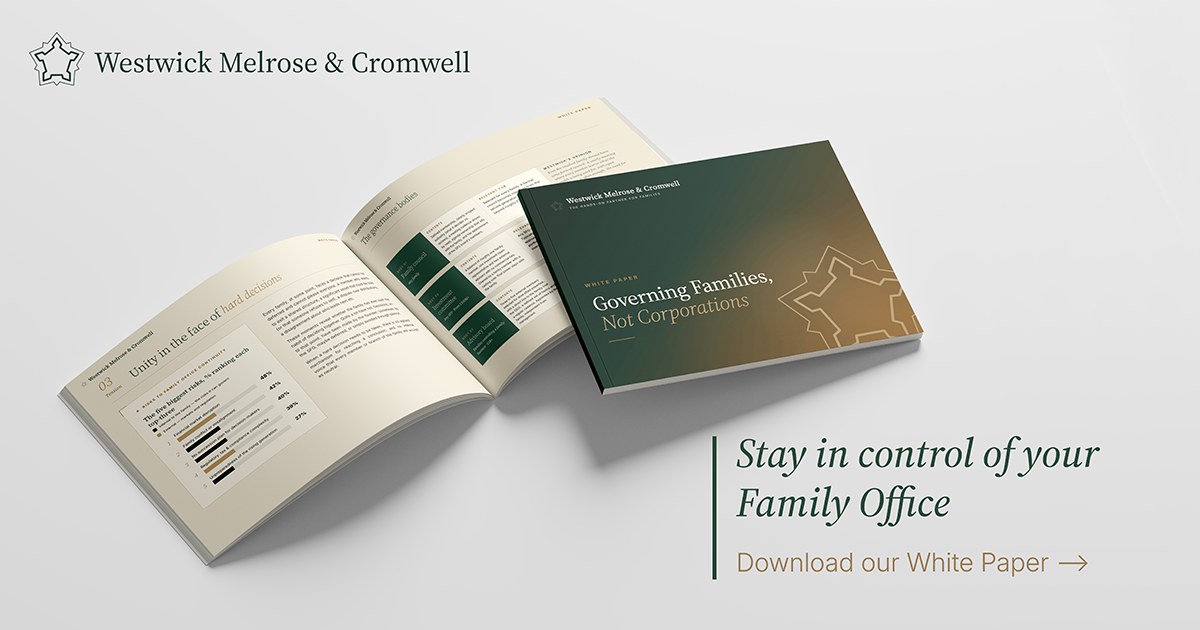 White paper
Governing Families, Not Corporations
Family governance is how families stay in control of their family office — the tensions, the tools, three real cases.
Read →
White paper
Governing Families, Not Corporations
Family governance is how families stay in control of their family office — the tensions, the tools, three real cases.
Read →
How to Choose a Wealth Manager for a Family Office
The durable criteria that separate a useful wealth manager from a well-marketed one, seen from inside a family office.
The Family Office Investment Committee: How Families Keep Control of Their Own Capital
The investment committee is where a family decides how its capital is used. Built well, it keeps the family in control. Built badly, it hands that control to the room. A practical guide to composition, mandate, and the line between deciding and executing.
Family Office Services: What a Family Office Actually Does
"Family office services" is what the market sells. Seen from inside the office, they are functions, and the list is shorter and harder than the brochures suggest. A working map of what a family office does, and what it should never delegate.
What Is a Family Office? A Practitioner's Guide
Everyone in wealth management now wants to sell to family offices. Few can say plainly what one is. A practitioner's definition: what a family office does, what it costs, and how to tell a real one from the label.
Family Office Succession Planning: Preparing the Family and the Office
Succession is the moment a family is most likely to lose control. Handled early, it becomes a family project. A practical guide to preparing the next generation, the knowledge one person holds, and the team that has to evolve.
Family Constitutions: What to Write, and What to Leave Out
Most family constitutions are long, bank-drafted and unread. The short one a family writes itself is the one it reaches for when a decision splits the family. What belongs in it, what to leave out, and who should hold the pen.
Single Family Office vs Multi-Family Office: Which Model Fits Your Family?
A practical comparison of the single family office and the multi-family office: what each model controls, where the economics make sense, and how families actually decide between them.
How to Choose a Family Office Adviser
The few durable criteria that separate a useful family office adviser from the crowd, and where the adviser's role ends and the family office manager's begins.
Family Office Club Deals: A Practical Guide to Co-Investing Well
A practical guide to family office club deals: how they come together, where they go wrong, and the due diligence and terms that make co-investing hold.
Selling a Family Business: Managing the Process in the Family's Interest
Selling a business is the family's decision. The process that follows lands on a family office already running at capacity. A practical guide to running a disposal, stage by stage, so it serves the family.
How to Set Up a Family Office
How to decide whether a single family office makes sense — and how to build one that actually serves the family rather than the advisers around it.
The Cost Structure of a Single Family Office
Running a single family office is expensive. How expensive depends on the size of the assets, the scope of the mandate, and above all on the discipline with which the office is built and managed.
What should our family wealth stand for? A values alignment guide for UHNW families
Aligning family wealth with shared values is one of the defining challenges of multigenerational wealth planning. This guide sets out how to approach it — from opening the conversation to translating shared principles into a coherent capital strategy.
The trustee in a family office — what the role requires and how to get it right
The duties of loyalty, prudence and care that govern a pension fund trustee govern a family office trustee equally. What differs is almost everything else: the regulatory framework, the investment mandate, the relationship with beneficiaries, and the time horizon over which the trustee is expected to think.
A practical guide to managing exits and buyouts in a single family office
Done well, an exit passes without leaving a mark. Done badly, it fractures the family for a generation. This guide sets out the elements to consider and the structures that, in our experience, actually hold.
What to expect behind family offices' "exclusive clubs"
"Buy-side only", "by invitation only", "principals only" — every week brings a new exclusive family office club. Families see the lure from miles away. A guide to which rooms are worth entering and which are selling something else.
A practical guide to onboarding the next generation in a family office
The industry calls it "the great wealth transfer" — a $68 trillion shift expected over the next two decades. Most family offices treat it as a technical matter for lawyers and tax accountants. They focus on the vessel and ignore the crew. The survival of a family's legacy depends on the transition from wealth to wisdom — and onboarding the next generation is the most important strategic priority a family will face.
Should you outsource your family office? A practical guide to what to keep and what to delegate
"Family Office as a Service" promises efficiency without the in-house burden. It also asks you to outsource the stewardship of your family's legacy — a very different question. A guide to what to keep, what to delegate, and where to draw the line.
Why there is no ideal family office structure — and what to build instead
Families are constantly offered "ideal" SFO structures built around tax efficiency or governance frameworks. Anyone who has spent time in the space knows the universal template does not exist.
There is no war for talent in single family offices
The "war for talent" in family offices is a story repeated at every event and on every LinkedIn feed. After thirty years in the trenches, the war is a phantom — and a profitable one for the people selling it.
Single Family Office: three archetypes for efficient transmission
When deciding what a family office is for, families can (and must) choose between three archetypes. Each serves a different purpose; each has a different risk profile; and each dictates what the rest of the structure should look like.